

At MindMine Education, one of the first things we tell families is this: the verbal sections of the ISEE and SSAT are not the kind of thing you can cram for in a few weeks. The vocabulary tested on both exams is intentionally above grade level.
A student sitting for the Middle Level ISEE, for example, will encounter words that go well beyond what their current classroom has covered. The students who perform best on these sections are the ones who have been building their vocabulary steadily for months or years before they ever register for a test.
The good news is that the most effective vocabulary building strategies are also some of the most enjoyable ones. Here is what we recommend starting well before the testing season arrives.
Read Widely and Often
Reading is the single most powerful vocabulary builder available to a child, and the research is clear on this point. According to NWEA, simply reading to children, taking turns reading with them, and having them read independently all contribute meaningfully to vocabulary growth. The more variety in what your child reads, the better. Fiction, nonfiction, biography, poetry, science writing, and history all introduce different registers of language and expose students to words they would not encounter in a single genre.
This is not about drilling word lists. It is about consistent, pleasurable exposure to language at a level that stretches what a child already knows. A child who reads one chapter of a challenging book each night for a year arrives at test prep in a very different place than one who has not.
16 Timed Sets for the Lower Level ISEE
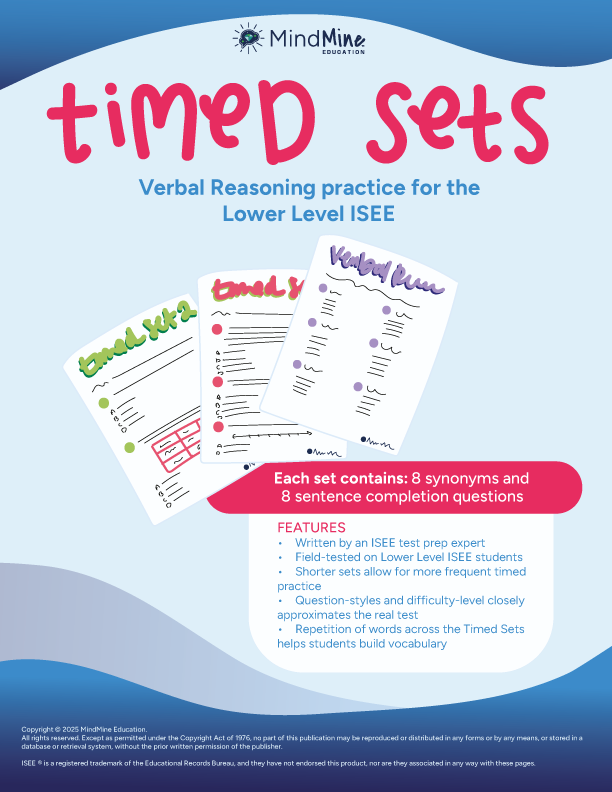
Verbal Reasoning practice sets with real test pacing
$12.50
Shop NowLower Level ISEE Verbal Reasoning Practice

Standalone practice section download
$5.00
Shop NowFocus on Word Roots, Prefixes, and Suffixes
One of the most practical vocabulary skills a student can develop before testing is the ability to break an unfamiliar word into its parts. A large portion of English vocabulary comes from Greek and Latin roots, and a student who knows that “bene” means good, “port” means carry, and “chron” means time can make educated guesses about dozens of words they have never seen before.
This matters a great deal on the ISEE and SSAT, where students regularly encounter words that fall outside any preparation list. Rather than guessing blindly, a student with strong morphology awareness can reason through an unfamiliar word and find a defensible answer.
The Iowa Reading Research Center at the University of Iowa notes that learning to use context clues, including the meaning of familiar word parts, is one of the most reliable strategies for building vocabulary across a student’s academic career. This is a skill that pays dividends far beyond a single test.
Related: The Most Common Verbal Reasoning Mistakes Students Make

Make New Words Part of Everyday Life
Looking up a definition and moving on is one of the least effective ways to actually retain a new word. According to ERB’s guidance on preparing for the ISEE, the best way to build vocabulary is to study a little bit each day, even just 10 to 15 minutes. We would add that the quality of that engagement matters as much as the quantity.
When a child encounters a new word, reading or hearing it in multiple contexts, using it in conversation, and writing it in a sentence all deepen retention in a way that a flash card alone does not. Some families keep a running “word of the week” habit at the dinner table. Others incorporate new vocabulary into games, stories, or everyday observations. The goal is for new words to feel like tools the child actually uses, not just items to memorize and forget.
Related: What Parents Should Know Before Their Child Takes the SSAT
Start Earlier Than You Think You Need To
Families often come to us a month or two before a scheduled ISEE or SSAT date and ask what they can do to improve verbal scores quickly. The honest answer is that quick fixes are limited. Vocabulary responds to sustained effort over time. A student who begins reading more challenging books in fourth or fifth grade and who develops word curiosity as a general habit will be in a much stronger position by the time seventh or eighth grade testing rolls around than one who begins any of this preparation in the weeks before the exam.
This does not mean that shorter timelines are hopeless. It means that the earlier families can start, the more options they have. Our ISEE and SSAT tutoring programs are designed to meet students where they are, but the foundation those programs build on is one that families can start laying right now, regardless of how far out testing is.
Related: How to Help Your Child Feel Confident on ISEE Test Day
Connect Vocabulary to What Your Child Already Loves
Vocabulary grows faster when a student is genuinely engaged with the material they are reading. A child who loves animals will absorb scientific and descriptive language naturally from books about wildlife or nature. A child who is passionate about history will encounter elevated vocabulary in context, with the added advantage of caring about what they are reading. Steering a reluctant reader toward the genre or topic they actually enjoy is almost always more effective than assigning a dry vocabulary workbook.
The test prep piece comes later. The foundation is curiosity, wide reading, and a growing comfort with language at a high level. If your family is thinking ahead about verbal readiness for the ISEE or SSAT, start there. If you want a clearer picture of where your child stands right now, our ISEE Readiness Audit is a good place to begin. Reach out whenever you are ready.
References:
- NWEA. Reading and Vocabulary: Why Your Kids Can Never Have Too Much of Either. nwea.org. https://www.nwea.org/blog/2025/reading-and-vocabulary-why-your-kids-can-never-have-too-much-of-either/
- Iowa Reading Research Center, University of Iowa. Supporting Your Children’s and Teens’ Home Learning: Using Context Clues to Understand New Words. irrc.education.uiowa.edu. https://irrc.education.uiowa.edu/blog/2020/10/supporting-your-childrens-and-teens-home-learning-using-context-clues-understand-new
- Educational Records Bureau. Tips for Every Section of the ISEE. erblearn.org. https://www.erblearn.org/blog/tips-for-every-section-of-the-isee/
Related:
- The Most Common Verbal Reasoning Mistakes Students Make
- What Parents Should Know Before Their Child Takes the SSAT
- How to Help Your Child Feel Confident on ISEE Test Day
