

One of the most common questions families ask when starting the independent school admissions process is a simple one: should my child take the ISEE or the SSAT?
The answer depends on a few things, and getting clear on the differences between these two exams can help families make a confident, well-informed choice. Here’s what you need to know.
They Are Different Tests Run by Different Organizations
The ISEE (Independent School Entrance Examination) is developed and administered by the Educational Records Bureau (ERB), a nonprofit educational organization.
The SSAT (Secondary School Admission Test) is administered by the Enrollment Management Association (EMA).
Both exams are designed to assess readiness for independent school admission, but they are built differently and test some skills in distinct ways.
16 Timed Sets for the Lower Level ISEE
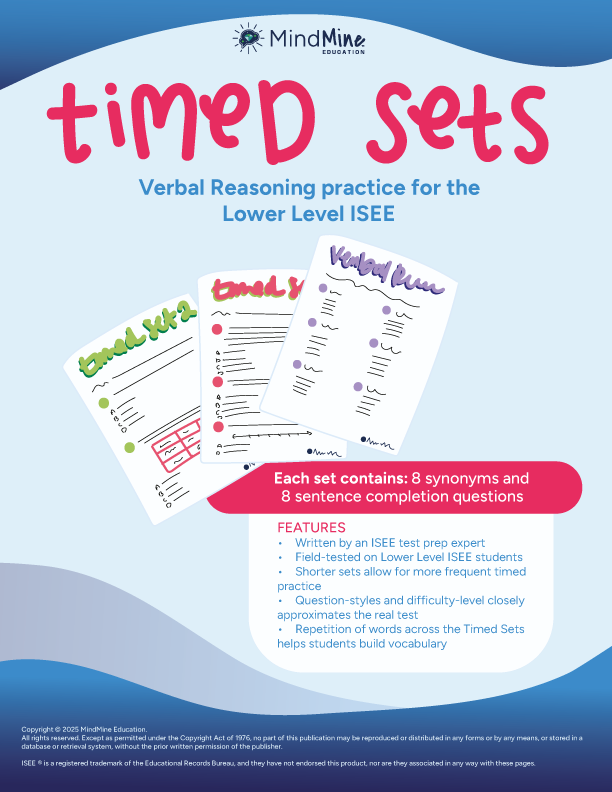
Verbal Reasoning practice sets with real test pacing
$12.50
Shop NowLower Level ISEE Verbal Reasoning Practice

Standalone practice section download
$5.00
Shop NowThe Structure Is Similar but the Details Matter
Both exams include verbal reasoning, math, reading comprehension, and an unscored writing sample. The differences show up when you look closely at each section.
- Verbal Reasoning: This is the most significant structural difference between the two tests. The ISEE verbal section includes synonyms and sentence completion questions. The SSAT verbal section includes synonyms and analogies. Analogies ask students to identify the relationship between a pair of words and find a parallel relationship among the answer choices, a question type that requires a different kind of reasoning than sentence completion does. Many students find analogies to be the more challenging format.
- Math: The ISEE covers a broader range of math topics, so students are more likely to encounter a few advanced concepts. Some students find the SSAT math sections slightly more manageable, though this varies quite a bit by individual. One structural note: on the ISEE, each multiple-choice question has four answer choices. On the SSAT, there are five, which reduces the odds when guessing.
- Reading Comprehension: The two tests are fairly comparable here. The SSAT is somewhat more likely to include passages from older texts, with longer sentences and less familiar phrasing, which some students find more time-consuming.
- Essay: Both tests include an unscored writing sample sent directly to the schools your child is applying to. Students have 30 minutes for the ISEE essay and 25 minutes for the SSAT (Middle and Upper Level). The SSAT offers two prompt choices; the ISEE offers one.
Related: Building a Strong Vocabulary Foundation in the Years Before Testing

The Guessing Strategy Is Different for Each Test
This is an important practical difference. The ISEE has no wrong-answer penalty, which means students should always answer every question, even when unsure. Leaving a question blank on the ISEE is simply a missed opportunity.
The SSAT works differently. On the Middle and Upper Level SSAT, a quarter point is deducted for each incorrect answer (the Elementary Level has no such penalty). This means blind guessing carries real risk, and students need to develop a deliberate strategy for when to answer and when to skip. For more on how the wrong-answer penalty works on the SSAT, the official SSAT scoring page breaks it down clearly.
Related: How to Help Your Child Feel Confident on ISEE Test Day
The Level Structure Is Similar but Not Identical
Both tests have multiple levels, though they define them differently: the ISEE assigns levels based on the grade a student is applying to enter, while the SSAT assigns levels based on the student’s current grade.
The ISEE has four levels: Primary (applying to grades 2 through 4), Lower (applying to grades 5 or 6), Middle (applying to grades 7 or 8), and Upper (applying to grades 9 through 12).
The SSAT has three levels: Elementary (for students currently in grades 3 or 4), Middle (current grades 5 through 7), and Upper (current grades 8 through 11).
Related: What Parents Should Know Before Their Child Takes the SSAT

Which Test Should Your Child Take?
In many cases, the school list drives the decision. Some schools require one test and not the other, so checking the admissions requirements of each school your child is applying to is always the right first step. Many schools accept either exam, which gives families more flexibility.
When there is a choice, a few things are worth considering. Students who find analogies intimidating may feel more at ease with the ISEE’s sentence completion format. Students who are strong, strategic test-takers who can manage a penalty-scoring system may find the SSAT manageable. If there is time before the application season begins, having a student try a practice section from each exam can be genuinely informative.
At MindMine Education, both the ISEE and SSAT are part of the work, and every family starts with a conversation about which test is the right fit for their child. If you are unsure where to begin, the ISEE Readiness Audit is a good starting point, and you are always welcome to reach out with questions.
References:
- Educational Records Bureau. ISEE by ERB. erblearn.org. https://www.erblearn.org/families/isee-by-erb/
- Enrollment Management Association. SSAT Scoring and Release Schedule. ssat.org. https://www.ssat.org/about/scoring/scoring-and-release-schedule
Related:
- Building a Strong Vocabulary Foundation in the Years Before Testing
- How to Help Your Child Feel Confident on ISEE Test Day
- What Parents Should Know Before Their Child Takes the SSAT
